Instagram Algorithm 2026: How Reach Really Works Now

CEO, Publora
TL;DR
How the Instagram algorithm works in 2026 - the separate systems for Feed, Reels, Stories, and Explore, why sends beat likes, and what Instagram says not to do.
The single most useful thing to understand about Instagram in 2026 is that there is no "the algorithm." Instagram runs separate ranking systems for Feed, Reels, Stories, and Explore, each tuned to a different job. A post that flies in Reels can sink in Feed, because the systems are asking different questions. Once you stop chasing one mythical formula and start matching content to each surface, reach gets a lot less mysterious.
Here's how each system works in 2026, the one signal that now matters most, and a few things Instagram itself says you should stop doing.
Instagram Is Four Algorithms, Not One
Instagram describes itself as "several AI systems," each ranking for a different intent. The short version:
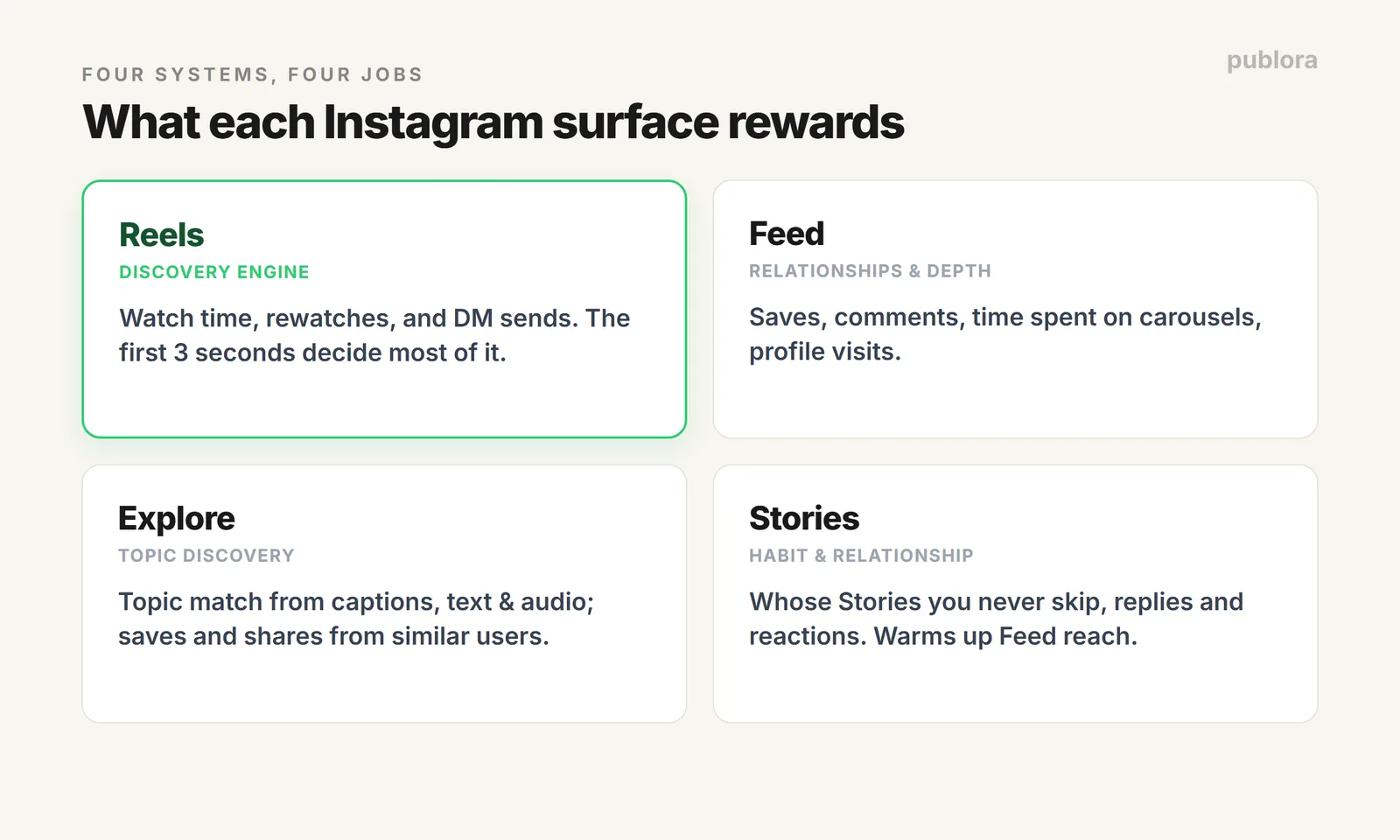
- Feed rewards relationships and depth — saves, comments, time spent on a carousel or long caption, profile visits.
- Reels is the discovery engine. Watch time, rewatches, and DM shares dominate; the first three seconds decide most of it.
- Stories is about habit and relationship — whose Stories you never skip, who you reply to. It rarely drives cold discovery; it warms up the relationships that then help your Feed reach.
- Explore is topic-driven discovery to people who don't follow you, matched by what your captions, on-screen text, and audio say your post is about.
One framing from a 2026 analysis of Meta's ranking notes sums it up well: reach is no longer a property of a post — it's a property of the relationship between an account, a viewer, and a surface.
The 2026 Shift: Sends Beat Likes
If you take one thing from this article, take this: private shares now matter more than likes. Adam Mosseri has said repeatedly that sends — when someone DMs your post to a friend — are one of the biggest ranking signals, precisely because they're hard to fake and signal real value.
The metric analysts now point to is "sends per reach": how many people shared your post divided by how many saw it. A Reel with a high send-to-reach ratio keeps getting pushed to new audiences. Several 2026 breakdowns call this the biggest algorithmic shift of the year, and Instagram has broadly moved to treating views, not likes, as the headline metric across formats.
The rough priority order for Reels and discovery in 2026: watch time and sends per reach > saves > likes and comments. So design for "I have to send this to someone" and "I'll save this for later," not for the double-tap.
Original Content Wins — and Watermarks Lose
Instagram tightened its originality preference hard. It prioritizes original content and reduces recommendation reach for accounts that repost others' work without transforming it — what the industry calls the "aggregator penalty." Reels detected as re-uploads, especially with a visible TikTok watermark, get heavily downranked, and the detection is multi-modal (it checks both audio and visuals). Persistent aggregator accounts can lose recommendation access entirely.
The takeaway is simple. Film your own clips, even simple ones. If you remix a trend, add real commentary or editing that changes it. And never post a video with another platform's watermark — re-export it natively first.
What Instagram Says NOT to Do in the First 24 Hours
This is the counterintuitive part, and it comes from Instagram's own creator best-practice guidance. In the first day after posting a Reel:
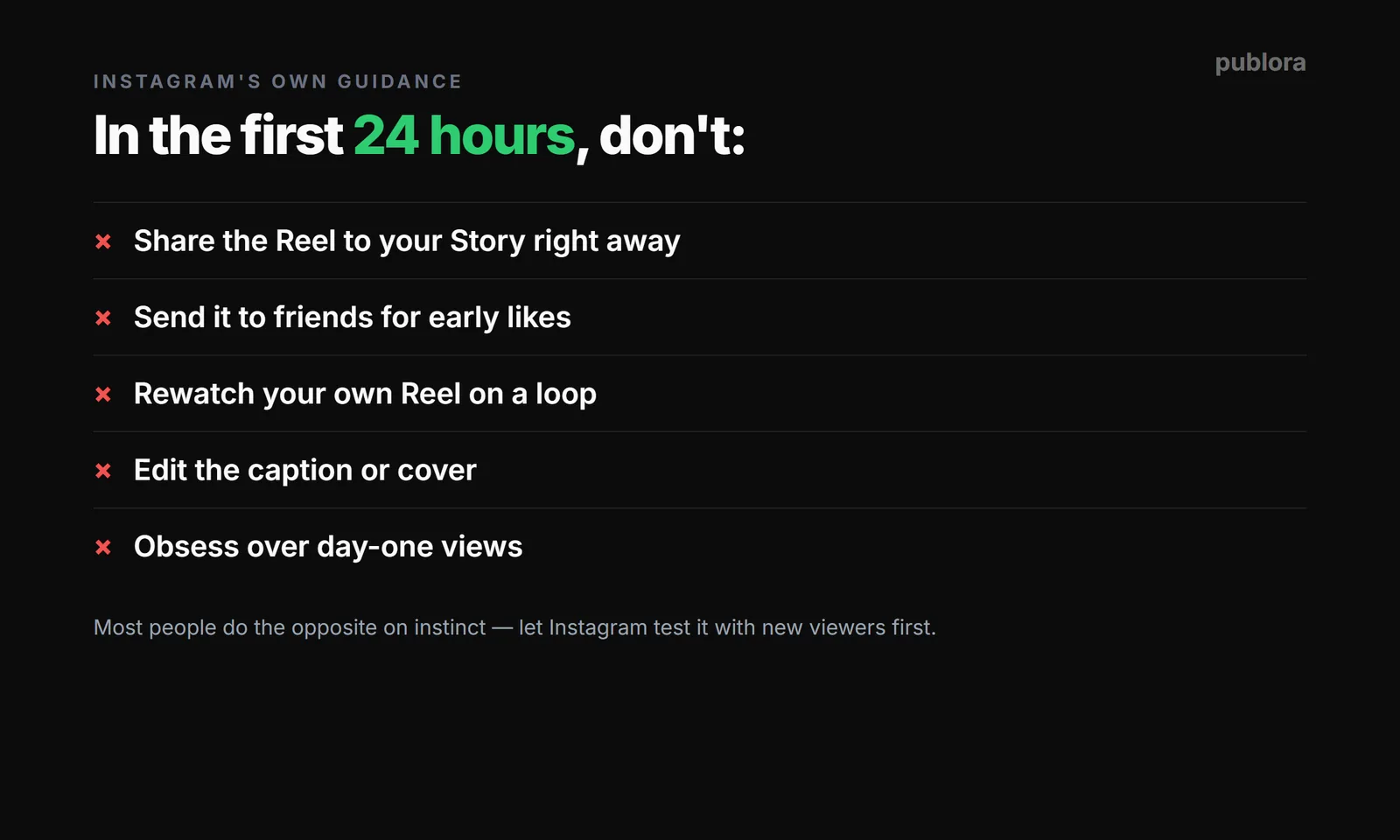
- Don't share it to your Story right away. Instagram wants to test the Reel with new viewers first; pushing it to your existing followers too early can limit how far it travels.
- Don't send it to friends for early likes. Friends tend to open but not watch fully, which creates low watch-time signals and tells the system the Reel isn't engaging.
- Don't rewatch your own Reel on a loop. It pollutes the early data the algorithm uses to judge real interest.
- Don't edit the caption or cover within 24 hours. Changing them too soon can slow distribution.
- Don't obsess over day-one views. Many Reels only ramp after 48–72 hours — focus on the next one.
Almost everyone does the opposite of this list on instinct. That's exactly why it's worth knowing.
How Often to Post in 2026
More is not better anymore. Posting too many Reels in a day can actually depress your account's distribution — over-posting is now a recognized drag. A sustainable, well-performing cadence for most accounts looks like:
- Reels: 4–6 per week (your main reach engine — Reels get roughly 1.5–2× the reach of static posts for smaller accounts).
- Carousels: 1–2 per week, for depth and saves.
- Stories: near-daily, to keep relationships warm.
Consistency is what lets each system learn who your audience is. That's far easier when you plan a week at once instead of scrambling daily — batching and scheduling your Reels and carousels keeps the cadence steady without the pressure to be "on" every day.
A Simple Reels Playbook
- Hook in the first 1–2 seconds — a bold line, a visual surprise, or a clear promise.
- One idea per Reel. Stuffing five tips in tanks retention.
- Make it shareable. A clear tip, a relatable scenario, or a checklist someone wants to forward — that's what drives sends per reach.
- Keep it tight — 10–45 seconds, native editing, readable on-screen text, real audio.
- Write like a human, not a brand. Generic, templated captions get tuned out — see how to write posts that don't sound like AI.
FAQ
How does the Instagram algorithm work in 2026?
There isn't one algorithm — Instagram runs separate ranking systems for Feed, Reels, Stories, and Explore, each tuned to a different intent. Across all of them, private shares (DM sends), watch time, and saves now matter more than likes, with a strong bias toward original, non-watermarked content.
What is the most important Instagram ranking signal in 2026?
For Reels and discovery, sends per reach — how often a post is shared in DMs relative to how many people saw it. Mosseri has called private sends one of the biggest signals because they're hard to fake. Saves rank just below; likes and comments are weighted lower.
Does Instagram penalize reposted or watermarked content?
Yes. Instagram prioritizes original content and reduces reach for accounts that repost without transformation. Reels with visible third-party watermarks get downranked, and persistent aggregator accounts can lose recommendation access.
How often should I post on Instagram in 2026?
Consistent but not spammy — around 4–6 Reels a week, 1–2 carousels, and near-daily Stories. Flooding the feed with multiple Reels a day can depress reach, so quality and shareability beat volume.
Keep a steady cadence without the scramble
Batch your Reels and carousels and schedule them with Publora — free Starter plan, no credit card.
Get Started FreeFurther Reading
- LinkedIn Algorithm 2026: How It Ranks Posts
- How to Schedule Instagram Posts
- Write Posts That Don't Sound Like AI
About the author. Written by the Publora team. Algorithm behavior is synthesized from 2025–2026 analyses, Instagram's own creator guidance, and Adam Mosseri's public comments; Instagram doesn't publish exact ranking weights, so treat specifics as well-sourced estimates, not official figures.
Related Articles
The Best Time to Post on X (Twitter) in 2026
Four published studies agree on Tuesday to Thursday mornings for X. The exact windows, the sample sizes behind them, and how to find your own best time.
The Best Time to Post on Threads in 2026
Buffer's analysis of 2.5 million Threads posts puts Thursday at 9am on top. The published windows, how much data sits behind them, and how to find your own.
How to Schedule Tweets in 2026 (Posts, Threads, and API)
How to schedule tweets in 2026: queue single posts and threads on X, handle the 280-character limit and image rules, or publish from a script or AI agent.
X (Twitter) Character Limit in 2026: The Complete Reference
The X (Twitter) character limit is 280 characters, but emojis count as two and URLs count in full. Every limit, how counting works, and what happens when you go over.