LinkedIn Algorithm 2026: How It Ranks Posts (and Why AI Search Cites Them)
TL;DR
How the LinkedIn algorithm works in 2026 - the AI ranking model, the signals that matter, what gets suppressed, and why your posts now show up in AI search.
Two things changed about LinkedIn in the last year, and together they rewrite how you should think about posting. First, the feed now runs on an AI ranking model that cares about depth far more than virality. Second — and this is the part most people haven't caught up to — LinkedIn has quietly become one of the most-cited sources in AI search. Your posts aren't just competing for the feed anymore; they're competing to be the answer ChatGPT and Google's AI give to a professional question.
Here's how the 2026 algorithm actually works, what it rewards and suppresses, and how to write posts that win in both the feed and AI search.
How the 2026 LinkedIn Algorithm Works
LinkedIn rebuilt its feed around large language models. The short version: the system now reads what your post is about and matches that meaning to each member's interests, instead of just counting likes and showing recent posts first.
Analysts describe a two-layer system. A retrieval layer (an LLM-based encoder) reads the semantic meaning of your profile and behavior, then pulls a pool of candidate posts — including from creators you don't follow, if the topic fits you. A ranking layer (a transformer-based "Generative Recommender") then orders those candidates by predicted relevance and engagement quality, not just likelihood of likes.
You may have seen this overhaul called "360Brew." Worth being precise: that name comes from consultant and media commentary, not LinkedIn's official documentation, which talks about "advanced ranking" and LLMs. The label matters less than the behavior — and the behavior rewards relevance, depth, and demonstrated expertise.
The Signals That Matter Now
The ranking model leans on four things, and likes are not high on the list.
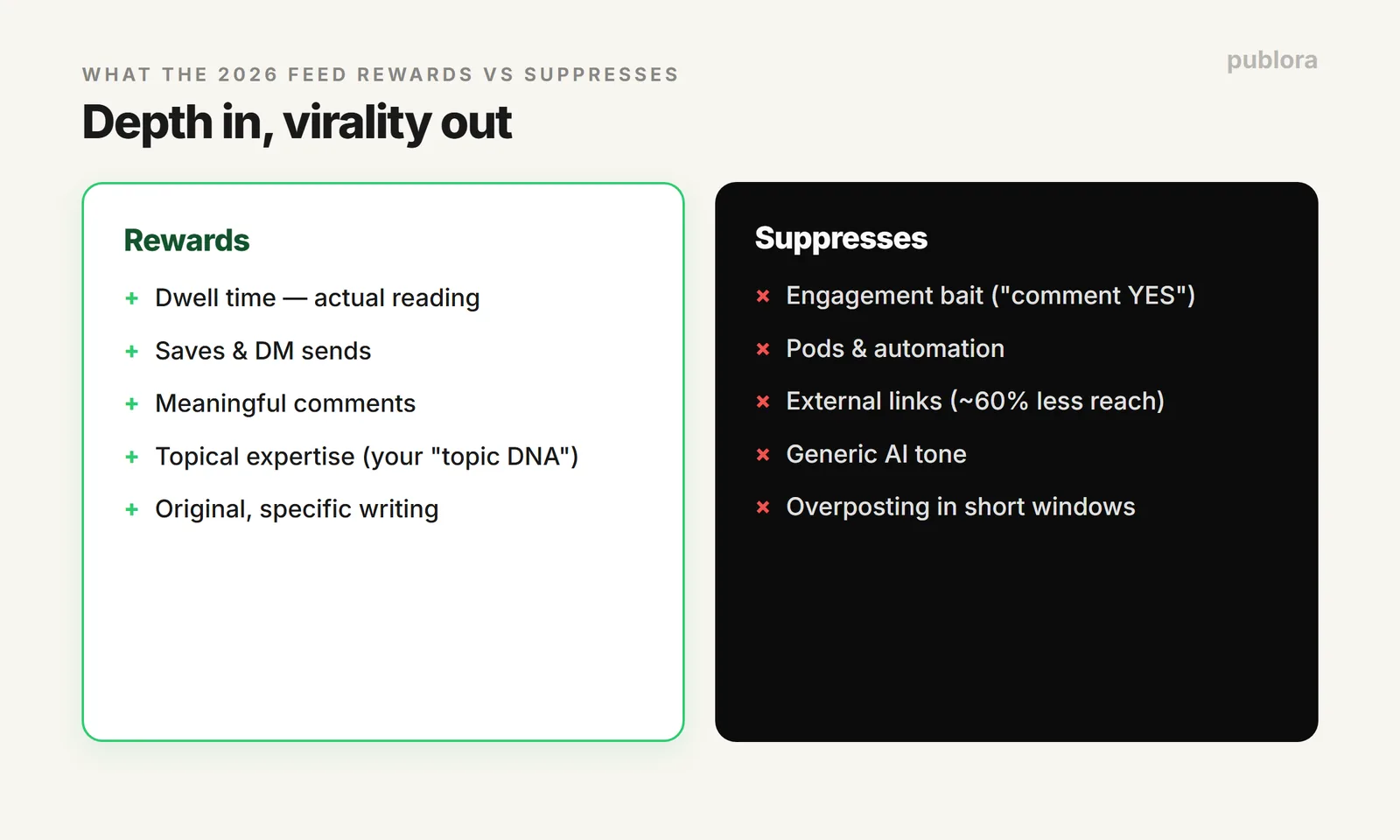
- Dwell time. How long people actually read your post. A post someone reads for 30 seconds beats one with 50 quick likes, and the system detects "click bounces" (open, then immediately leave) and downranks them.
- Meaningful comments. Thoughtful replies and conversations that keep going past the first hour carry real weight. Pod comments and one-word automation replies are negative signals.
- Saves and sends. Bookmarks and DM shares are strong signals that a post was genuinely useful — they often matter more than public likes.
- Topical expertise. The model builds a sense of your "topic DNA" — the subjects you consistently post about — and pushes those posts wider, even beyond your network. A clearly defined profile (role, industry, niche) helps it find the right audience.
The First Few Hours Are a Quality Test
When you publish, LinkedIn shows the post to a small slice of your network — roughly 2–5% — and watches the early quality signals: dwell time, saves, sends, and comment depth. If those look good, it scales distribution to topically relevant people, including second- and third-degree connections. If they don't, the post mostly stays put — one 2026 analysis found only about 5% of posts that underperform in the first hour ever recover to broad reach.
The nuance: recency itself is no longer the main ranking factor. A genuinely strong post can keep surfacing for days or weeks. So the first hours are an important test, but sustained, depth-focused engagement over days beats a quick spike that goes nowhere.
What Gets Suppressed in 2026
- Engagement bait. "Comment YES if you agree," "Like this if…" — explicitly flagged and downranked.
- Pods and automation. Coordinated or obviously automated engagement reads as manipulation.
- External links. Most data still shows a meaningful penalty — one 2026 study measured around 60% less reach versus a link-free equivalent, and "link in first comment" is no longer a reliable workaround. Put the value in the post; add links sparingly.
- Generic AI tone. It's not that AI assistance is banned — it's that template-like, buzzword-heavy, low-specificity writing reads as low quality. Posts that sound like everyone else get treated like filler.
- Overposting. Blasting several posts in a short window is a suppression trigger.
Ideal Length and Frequency
There's no official word count, but the dwell-time logic points to concise but substantive posts — roughly 150–600 words, readable in 15–45 seconds, that deliver one clear insight or story. For documents and carousels, keep them to 6–10 slides; LinkedIn now checks completion rate, and long decks that lose people get penalized.
On frequency, the 2026 algorithm doesn't reward volume. Most guidance lands on one strong post a day or three to five a week, on a consistent topic. Because each post runs through that early quality test, flooding the feed with average posts dilutes your performance — and good posts keep working for days, so you don't need to post constantly. This is exactly where scheduling helps: pick your slots, batch a week of genuinely good posts, and keep the cadence steady without the daily scramble.
The New Game: Your Posts Now Show Up in AI Search
This is the shift most people haven't priced in. AI answer engines — ChatGPT, Google's AI Mode and Overviews, Gemini, Copilot, Perplexity — lean heavily on LinkedIn for professional questions. In early-2026 analyses (Semrush across ~89,000 cited URLs, plus Profound's professional-query study), LinkedIn appeared in around 11% of AI answers on average and was the #1 cited domain for professional and B2B queries on every platform examined.
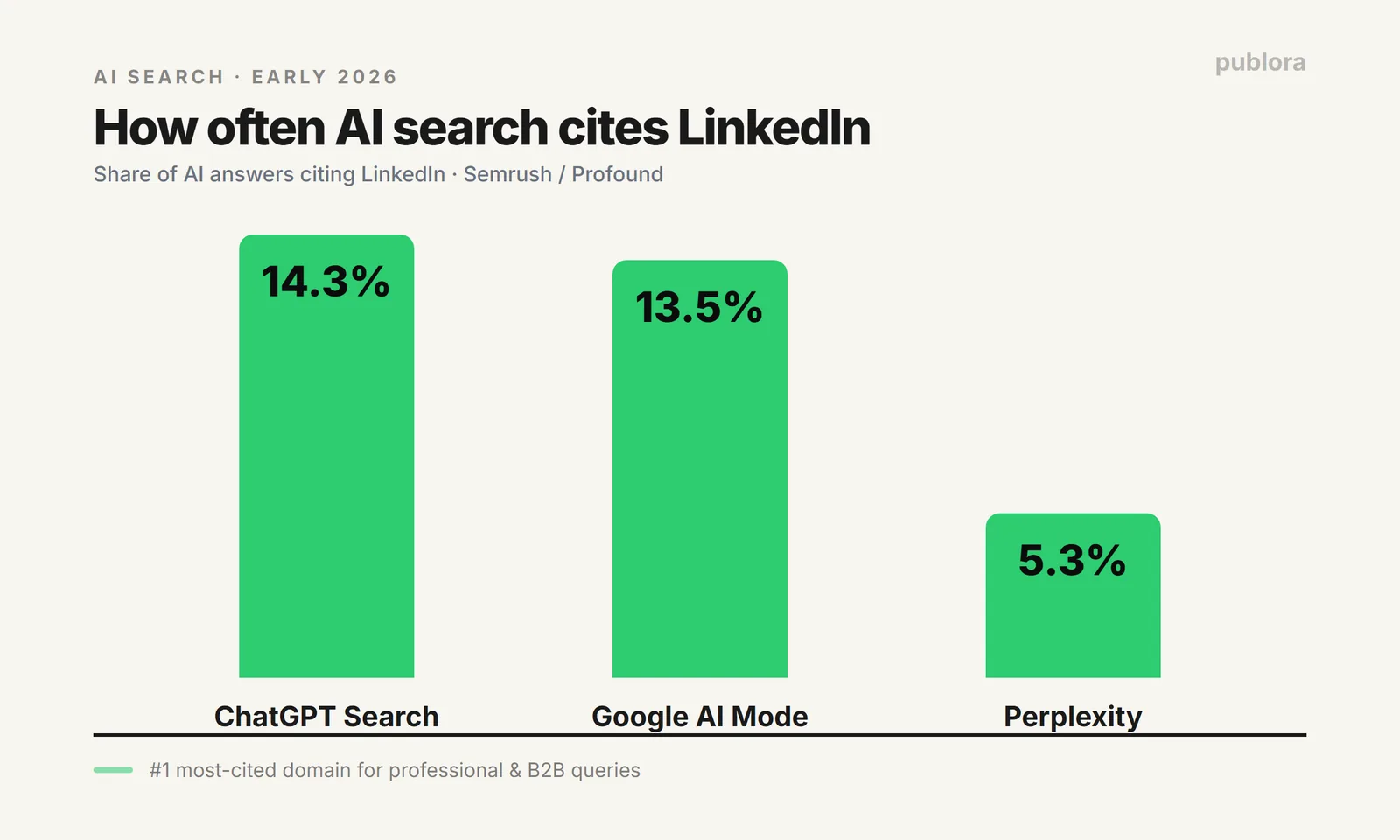
The breakdown by platform: LinkedIn was cited in about 14.3% of ChatGPT Search answers, 13.5% of Google AI Mode answers, and 5.3% of Perplexity answers. And what gets cited is telling — long-form articles and newsletters drive 50–66% of LinkedIn's AI citations, and roughly 95% of citations come from original content, not reshares. Notably, likes and comments have near-zero correlation with whether a post gets cited: the AI layer is decoupled from the feed's engagement game.
How to Make LinkedIn Content AI-Citable
Getting cited by AI rewards a different discipline than going viral. AI systems parse structure, not vibes. To make your posts and articles citable:
- Write the long-form version. Articles and newsletters in the 500–2,000 word range earn the bulk of citations. Concise posts work too when they squarely answer a specific question (the cited sweet spot for posts is 50–299 words).
- Use clear headings and answer blocks. Lead each section with a 30–80 word paragraph that directly answers the question in the heading, then add your story or proof. AI extracts content that stands on its own.
- Be original and opinionated. Reshares barely get cited. Your own framing of a topic is what the model paraphrases.
- Keep it current. AI engines favor content from the last 12–24 months. Update your flagship articles annually.
- Post consistently on one topic. Cited authors tend to publish regularly in their niche — consistency builds the topical authority both the feed and the AI layer reward.
If you want the practical posting side, our guides on how to schedule LinkedIn posts and the best time to post on LinkedIn pair well with this.
What This Means for You
Stop optimizing for likes. The 2026 algorithm and the AI search layer both reward the same thing: clear, original, expert content on a consistent topic, written so a human wants to read it and a machine can parse it. Post fewer, better pieces; keep a steady cadence; and treat your best LinkedIn articles as assets that can be cited for years, not posts that die in a day.
FAQ
How does the LinkedIn algorithm work in 2026?
It runs on an AI ranking system built on large language models: a retrieval layer reads the meaning of your profile and a post, then a transformer-based ranker orders posts by predicted relevance and engagement quality. It rewards dwell time, saves, and meaningful comments over raw likes and recency.
What is 360Brew?
It's an industry/consultant nickname for LinkedIn's 2025–2026 AI ranking overhaul, not an official product name. LinkedIn's own materials say "advanced ranking," LLMs, and "Generative Recommender." The takeaway: a clear profile and on-topic content help the model show your posts to the right people.
Do external links reduce LinkedIn reach in 2026?
Most data still shows a meaningful penalty — roughly 60% less reach versus a link-free equivalent in one 2026 analysis — and the "link in first comment" workaround is no longer reliable. Keep the value in the post and add links sparingly.
Is LinkedIn content cited in AI search engines?
Yes. In early-2026 studies LinkedIn appeared in about 11% of AI answers on average and was the most-cited domain for professional queries across ChatGPT, Google AI Mode, Gemini, Copilot, and Perplexity. Long-form articles and newsletters drive most of those citations.
How often should I post on LinkedIn in 2026?
Fewer, better posts win — one strong post a day or three to five a week, on a consistent topic. Overposting is a suppression signal, and good posts keep surfacing for days, so depth and consistency beat volume.
Post consistently without the daily scramble
Batch a week of strong LinkedIn posts and schedule them with Publora — free Starter plan, no credit card.
Get Started FreeFurther Reading
- How to Schedule LinkedIn Posts in 2026
- Best Time to Post on LinkedIn in 2026
- Social Media Scheduling API: Post to 10 Platforms with One Call
About the author. Written by the Publora team. Algorithm behavior and AI-citation figures are synthesized from 2025–2026 analyses (including Semrush and Profound studies) and practitioner breakdowns; LinkedIn doesn't publish exact ranking rules, so treat specifics as well-sourced estimates, not official numbers.
Related Articles
The Best Time to Post on X (Twitter) in 2026
Four published studies agree on Tuesday to Thursday mornings for X. The exact windows, the sample sizes behind them, and how to find your own best time.
The Best Time to Post on Threads in 2026
Buffer's analysis of 2.5 million Threads posts puts Thursday at 9am on top. The published windows, how much data sits behind them, and how to find your own.
How to Schedule Tweets in 2026 (Posts, Threads, and API)
How to schedule tweets in 2026: queue single posts and threads on X, handle the 280-character limit and image rules, or publish from a script or AI agent.
X (Twitter) Character Limit in 2026: The Complete Reference
The X (Twitter) character limit is 280 characters, but emojis count as two and URLs count in full. Every limit, how counting works, and what happens when you go over.