How to Write Social Media Posts That Don't Sound Like AI

TL;DR
AI-sounding posts get scrolled past and downranked. Here's how to spot the tells and write social media posts that read like a real person wrote them.
You can usually feel it in the first line. The post is grammatically perfect, vaguely motivational, and says almost nothing. It "leverages synergies" and wants to "elevate your journey." Nobody talks like that, so readers scroll past, and as of 2026 LinkedIn's ranking quietly treats that generic AI tone as a low-quality signal. Sounding like a robot is now a reach problem, not just a style one.
The good news: the tells are predictable, and once you can see them, they are easy to remove. Here is how to write posts that read like a person wrote them, even when AI helped with the draft.
The Tells That Give AI Writing Away
AI writing has an accent. These are the most common giveaways:
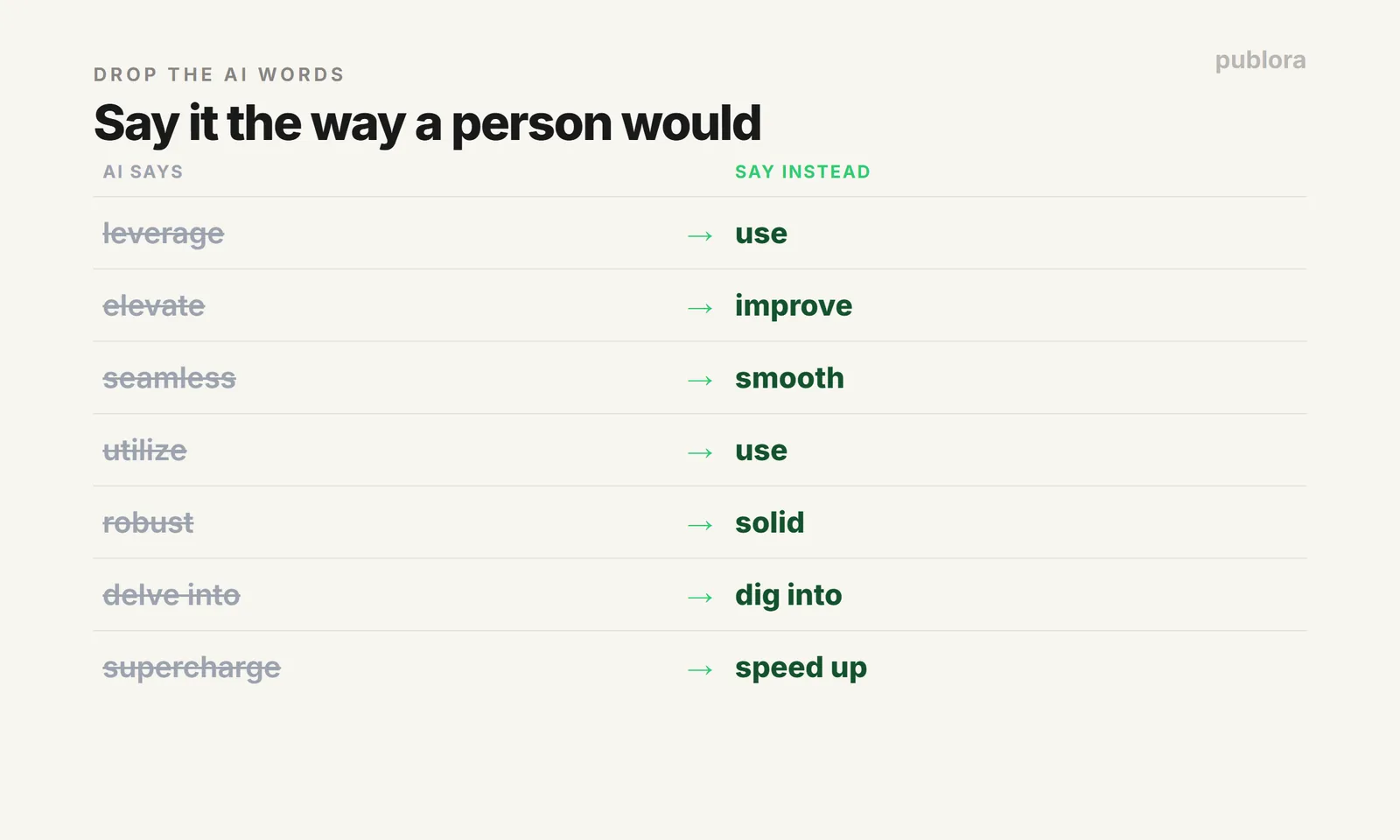
- Buzzwords. "Leverage," "elevate," "seamless," "robust," "unlock," "delve," "supercharge." Real people say "use," "improve," "smooth," "solid."
- Same-length sentences. AI tends to write in a steady, even rhythm. Human writing has short jabs and longer runs. The variation is what makes it sound like a voice.
- Hedging and filler. "It's worth noting that," "in today's fast-paced world," "when it comes to." These add words and remove confidence.
- Fake enthusiasm. "I'm thrilled to share," "super excited," a string of emojis. Forced energy reads as a press release.
- No specifics. The fastest tell of all. AI writes "many businesses see significant results." A person writes "we cut posting time from two hours to ten minutes."
- Tidy, hollow endings. "At the end of the day, it's all about connection." A neat bow that means nothing.
Before and After
Same idea, written two ways. Read both out loud and you'll hear the difference immediately.
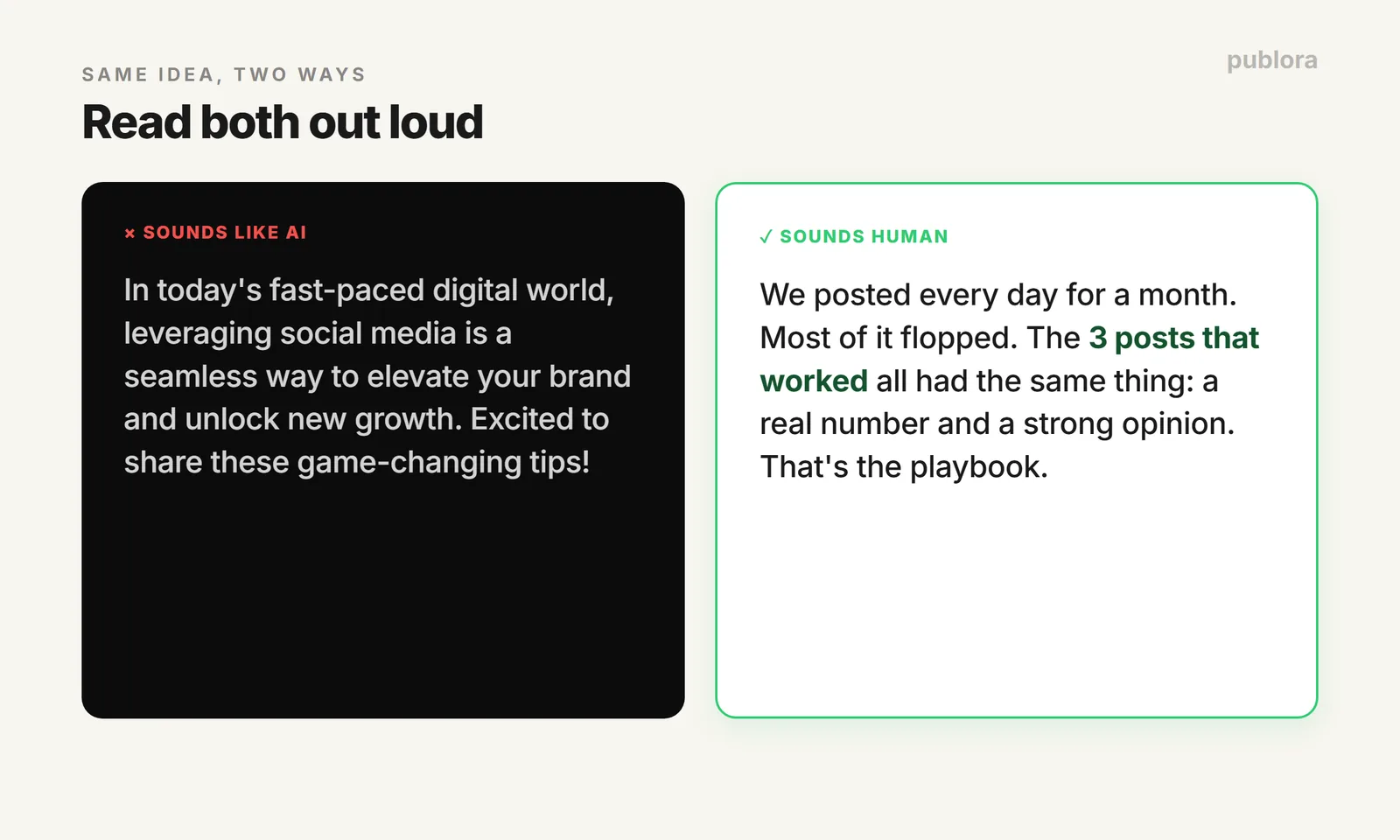
The AI version is longer and says less. The human version is shorter, names a real number, and admits a small truth. That is the whole trick, repeated.
Six Habits That Fix It
You don't need a rulebook. These six moves cover most of it.
- Use plain words. If you wouldn't say it to a friend over coffee, don't write it. "Use," not "utilize."
- Vary your sentence length. Follow a long sentence with a short one. Let one line stand alone. The rhythm is what sounds human.
- Get specific. Swap every "many" and "significant" for a real number, name, tool, or moment. Specifics are the opposite of AI.
- Say one thing. One idea per post beats five half-ideas. If you have two points, write two posts.
- Be honest, including the bad parts. Admit what didn't work or what you're unsure about. AI never does this, so it instantly reads as real.
- Read it out loud. Your ear catches what your eye misses. If you stumble or cringe, rewrite that line.
You Can Still Use AI — Just Don't Let It Hit Publish
None of this means dropping AI tools. They're great for getting past a blank page, listing angles, or drafting a rough version you'd never have started otherwise. The mistake is shipping that draft as-is.
Treat AI as a drafting partner and yourself as the editor. Generate the draft, then do one pass with a red pen: cut the buzzwords, add one real example, break up the even rhythm, and delete the tidy ending. Five minutes of human editing turns a generic draft into something that sounds like you. The model that writes the fastest first draft still makes the worst final editor.
This matters more than ever for the platforms that now reward depth and specificity. If you write for LinkedIn, it pairs directly with how the 2026 LinkedIn algorithm ranks posts.
Quick Pre-Publish Checklist
- No buzzwords (leverage, elevate, seamless, delve, unlock, supercharge).
- At least one specific number, name, or example.
- Sentence lengths vary — not all the same.
- One clear idea, not five.
- An honest line a robot wouldn't write.
- It survives being read out loud.
FAQ
Why do my posts sound like AI wrote them?
Usually a few habits: buzzwords like "leverage" and "elevate," sentences that are all the same length, hedging ("it's worth noting"), fake enthusiasm, generic openers, and no specific details. Strip those out and most writing stops sounding like AI.
Does AI-sounding content hurt reach?
It can. LinkedIn's 2026 ranking treats generic, AI-style phrasing as a low-quality signal, and readers scroll past templated posts. The fix isn't to avoid AI tools — it's to make the output specific, plain, and human before publishing.
Can I still use AI to write posts?
Yes. Use AI for a first draft or to beat the blank page, then edit it like a human: cut the buzzwords, add a real number or example, vary the sentence length, and read it out loud. AI is a good drafting partner and a bad final editor.
Write it once, post it everywhere
Draft a human post, then schedule it across 10 platforms with Publora. Free Starter plan, no credit card.
Get Started FreeFurther Reading
About the author. Written by the Publora team, who spend a suspicious amount of time deleting the word "leverage" from drafts.
Related Articles
What Is a Photo Dump? (And How to Post a Good One)
A photo dump is a casual carousel of loosely related photos posted together. What the format is, why it works, and how to put one together that people finish.
AI Content Creation for Social Media: From Idea to Published Post in One Command
Use Claude or GPT to generate platform-specific social media content and publish via Publora MCP in one command. Prompt engineering tips, quality control, and workflow examples.
How to Overcome Creative Block: Tips to Reignite Your Creativity
Beat creative block with a reliable process. Build systems that keep ideas flowing even on days when inspiration feels impossible.
9 Creative Instagram Post Ideas to Spark Engagement
Stand out with 9 creative Instagram post ideas. Shift from simply posting to strategically connecting with your audience.