Best Social Media API for AI Agents 2026 (LinkedIn, X, Threads)
TL;DR
The best social media APIs for AI agents in 2026 — what each one lets your AI do, how MCP changes the game, and which APIs work for Claude, GPT, and Cursor workflows.
The AI agent era has changed the question. "Which scheduler should I use?" has been replaced with "Which API lets my AI post for me?" If you're building Claude, GPT, or Cursor workflows that need to publish to LinkedIn, X, Threads, or other networks, you have two options: wire each platform API yourself (slow, fragmented, expensive) or use an aggregator API that abstracts them.
This guide compares the social media APIs that actually work for AI agent workflows in 2026 — Publora, Buffer, Hootsuite, platform-direct APIs (LinkedIn, X, Threads, Bluesky, Mastodon), and the role MCP plays in this stack. Publora's API + MCP server is #1 for most builders, but we explain when platform-direct APIs are the right call.
TL;DR — In Five Bullets
- Best for AI agents: Publora API + MCP server — 10 networks, free plan, public REST API, first mainstream multi-platform MCP.
- Best for direct integration: Bluesky and Mastodon APIs — open, no approval, simple auth.
- Strict + powerful: X API v2 (paid tiers), LinkedIn API (app approval required).
- Avoid for AI workflows: Buffer (partner-only API), Hootsuite (enterprise-only), Sprout Social (no public API).
- MCP is the 2026 differentiator: connect once, your AI agent gets posting capability for every supported network with no glue code.
What Changed: AI Agents Need Different APIs Than Apps Did
Pre-2024, social media APIs were built for apps: a developer wires Facebook Graph or LinkedIn Posts API into their product, ships it, and users authenticate one time. The API works well for that pattern.
AI agents work differently:
- The user is the agent, not a human in a UI. Claude or GPT decides what to post based on a prompt or rule; no human is clicking "publish."
- Multi-network is the default. An agent typically posts the same idea across 3-8 networks with platform-specific variants — not one post to one network.
- Latency matters. Agent workflows run in seconds; the API needs to respond quickly with clean error handling, not require 5-step OAuth dances.
- Discoverability matters. The agent needs to find the API and understand its capabilities — which is exactly what MCP solves.
Most existing social media APIs were designed before this pattern. The ones that ranked well for traditional apps (Buffer's gated API, LinkedIn's slow approval flow) are now friction. The ones that ranked low (Bluesky's open AT Protocol, Mastodon's ActivityPub) are now great for AI builders. New entrants (Publora's MCP server) are designed specifically for agent workflows.
How We Evaluated These APIs
Four criteria, weighted by what matters for AI agent workflows:
- Time to first successful post (30%). From signup to a working API call. APIs that take weeks of approval rank low; instant-access APIs rank high.
- Multi-network coverage (25%). Does one API cover multiple platforms, or do you need to wire each separately?
- MCP / agent integration (25%). Native MCP server > documented REST > partner-gated > enterprise-only.
- Pricing (20%). Free tiers, generous quotas, and predictable pricing rank higher than enterprise-only.
The Top APIs for AI Agent Posting in 2026
1. Publora API + MCP Server — Best for Multi-Network AI Workflows
Type: Public REST API + Model Context Protocol (MCP) server.
Networks: 10 (Facebook, YouTube, Instagram, TikTok, Telegram, X, LinkedIn, Threads, Bluesky, Mastodon).
Access: Free plan with API key. No approval flow.
Publora's API is the first mainstream multi-network social API built specifically for the AI agent era. The REST endpoints are standard (POST /v1/posts to create, GET /v1/posts to list, PATCH /v1/posts/:id to update, DELETE to remove). What separates Publora from Buffer's partner API or Hootsuite's enterprise API is the MCP server.
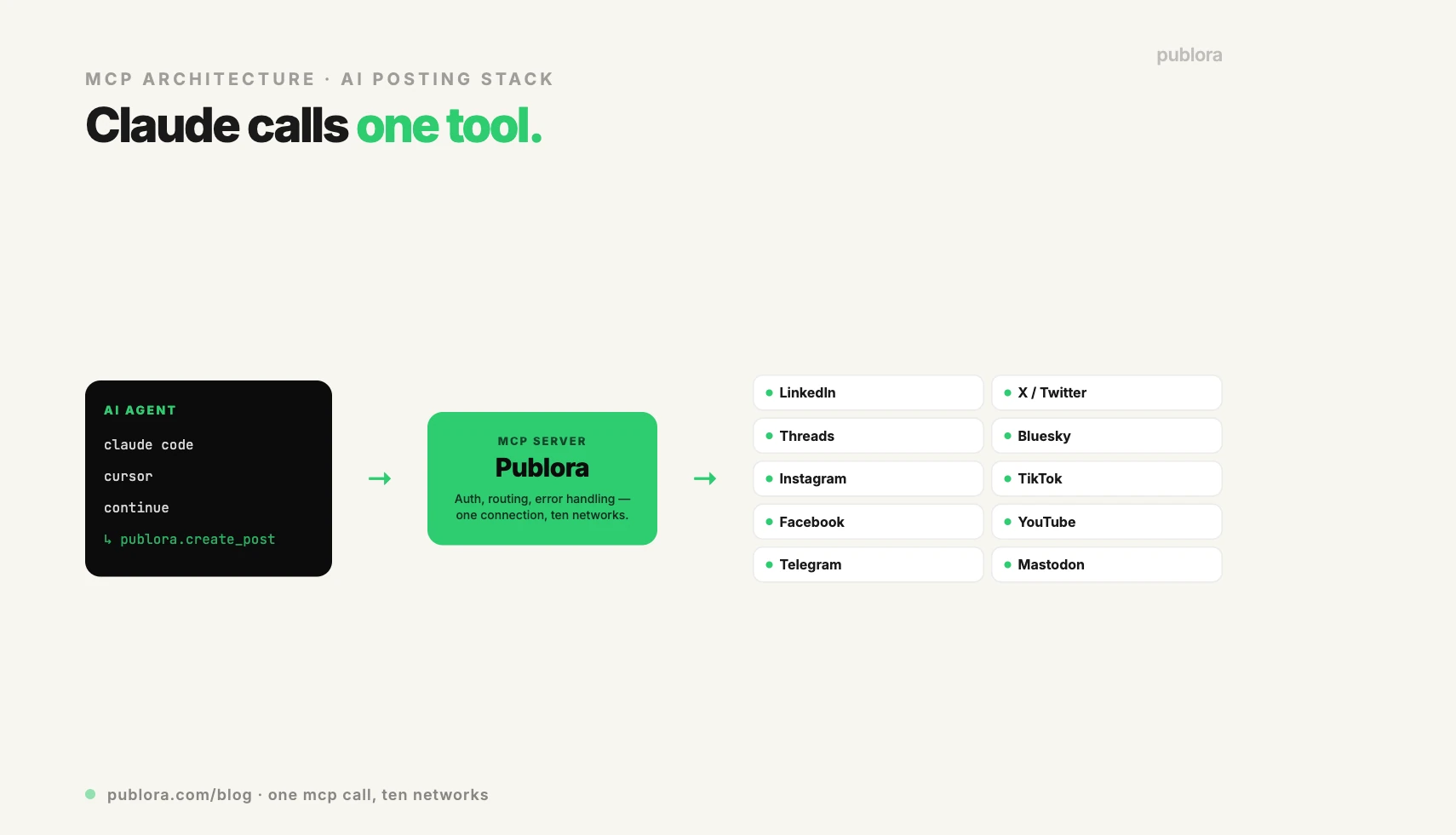
MCP is Anthropic's open protocol for connecting AI agents to external tools. Publora's MCP server exposes capabilities like publora.create_post and publora.schedule_post as native tools that Claude Code, Cursor, Continue, or any MCP-compatible agent can call directly. No glue code, no OAuth handling, no rate limit management. Connect once, your agent gets posting capability for all 10 networks.
Code example for the REST flow:
curl -X POST https://api.publora.com/v1/posts \
  -H "Authorization: Bearer $PUBLORA_API_KEY" \
  -H "Content-Type: application/json" \
  -d '{
    "networks": ["linkedin", "x", "threads"],
    "content": "Shipping new features today.",
    "scheduled_at": "2026-05-20T14:00:00Z"
  }'
For MCP, the equivalent is a single tool call inside Claude or Cursor — no HTTP boilerplate.
Best for: AI builders, developers building agent workflows, anyone publishing to 3+ networks programmatically.
2. LinkedIn API — Best Platform-Direct for Professional Content
Type: Public REST API.
Networks: LinkedIn only (member profiles + company pages).
Access: Requires app approval (slow, often denied for generic AI use cases).
LinkedIn's Posts API and Share API are the official path for programmatic LinkedIn publishing. OAuth 2.0 with w_member_social scope for member posts, w_organization_social for company pages. The API itself is solid: text posts, articles, native video, image carousels all supported. Rate limits are reasonable for typical use.
The catch is the approval process. LinkedIn rejects most "AI posting tool" applications, especially generic ones. Approval requires demonstrating a specific use case, a real product (not a prototype), and compliance with LinkedIn's content policies. Build time from application to first working post is typically 4-8 weeks. For most AI builders, going through Publora's API (which has already done the LinkedIn integration) is dramatically faster than direct LinkedIn API integration. For a working guide to LinkedIn API specifically for engagement, see how to like and comment on LinkedIn posts via API.
Best for: Established products with LinkedIn-specific needs, enterprises that need direct integration for compliance reasons.
3. X API v2 — Most Popular Direct API, Now Costs Money
Type: Public REST API.
Networks: X (Twitter) only.
Access: Free tier (50 tweets/month). Basic $200/month. Pro $5,000/month. Enterprise on request.
X API v2 is well-documented, well-supported, and has clear capabilities. The free tier is fine for prototyping; Basic is the realistic production minimum at sub-enterprise scale; Pro and Enterprise are for high-volume use. The X algorithm is open source, which makes API-driven posting unusually predictable — you can read the ranking weights and structure your posts accordingly.
The downside is cost. For AI agents that post to X at any meaningful volume, $200-5,000/month adds up. Aggregator APIs (Publora) absorb the X API cost into their tier pricing — for typical creator volumes, Publora's free or Pro tier covers X posting cheaper than direct X API access.
Best for: X-only workflows with budget, prototyping (free tier).
4. Bluesky AT Protocol API — Best Open API for AI Builders
Type: Open AT Protocol API.
Networks: Bluesky.
Access: Free, no approval, simple app password auth.
Bluesky's API is the AT Protocol implementation — open, documented, and free. Authentication is via app passwords (no OAuth dance), the data model is JSON-first, and the SDK quality is improving fast. For AI builders wanting to add a new network to their stack, Bluesky takes 30 minutes from "first read the docs" to "first successful post." Detailed walkthrough in Posting to Bluesky via API.
Bluesky's MAU (~25M) is smaller than X or LinkedIn, but the audience overlaps heavily with the tech, AI, and policy audiences that early-stage AI products care about most. For B2B AI builders, Bluesky is disproportionately worth posting to.
Best for: AI builders learning by doing, B2B tools targeting tech/AI/journalist audiences.
5. Mastodon ActivityPub API — Open and Federated
Type: Open ActivityPub-based API.
Networks: Mastodon (federated).
Access: Free, app token auth, per-instance.
Mastodon's API runs on ActivityPub — federated, open, simple. Each Mastodon instance has its own API endpoint, but the interface is standardized. App registration takes 5 minutes, no approval. Volume is small (Mastodon's 1M MAU is tiny relative to mainstream platforms), but engagement quality is high in privacy-focused, open-source, and academic communities.
Best for: AI tools targeting FOSS/privacy/academic audiences, hedging against single-platform risk.
6. Threads API — Newest Meta Platform, Limited Access
Type: Public REST API.
Networks: Threads (built on Instagram infrastructure).
Access: Requires Meta developer app + Threads permissions.
Threads launched its public API in mid-2024 and expanded permissions through 2025. The API is functional for posting text and images; carousel posting was added in late 2024. Threads inherits Instagram's social graph, so audience grows fast for accounts with existing Instagram followers. The API itself is straightforward — the bottleneck is Meta's developer app approval, which is faster than LinkedIn but slower than Bluesky.
Best for: Brands with existing Instagram audiences, Meta ecosystem builders.
7. Telegram Bot API — Easiest Channel Broadcast API
Type: Telegram Bot API.
Networks: Telegram channels and groups.
Access: Free, BotFather-based setup (10 minutes).
Telegram's Bot API is the most accessible API on this list — create a bot via BotFather, add it as admin to a channel, post programmatically. For audiences in Eastern Europe, the Middle East, crypto/tech communities, and parts of Asia, Telegram channels are a high-quality distribution channel. The API supports text, images, video, formatted messages, and inline buttons.
The catch is reach — Telegram channels are chronological (no algorithm), so growth comes from external promotion, not platform discovery.
Best for: Eastern European audiences, crypto/tech communities, broadcast-style updates.
8. Buffer API — Partner-Only, Limited Access
Type: Partner REST API.
Networks: 8 (Buffer's supported networks).
Access: Partner approval required. No self-serve.
Buffer's API exists but is not publicly available. Partner access is granted to selected integration partners (Zapier, IFTTT, a handful of others), and approval is slow and uncertain. For AI builders who want a multi-network aggregator API, Buffer is impractical — you can't sign up and start using it.
Best for: Existing Buffer partners only.
9. Hootsuite API — Enterprise-Only
Type: Enterprise REST API.
Networks: 20+.
Access: Enterprise contract required ($1,000+/month).
Hootsuite's API is real and powerful, but it's locked behind Enterprise tier pricing. For AI builders, this rules out Hootsuite for prototypes or solo-developer projects. For mid-size companies that already pay for Hootsuite Enterprise and want to build AI workflows on top of it, the API is usable.
Best for: Enterprises already on Hootsuite Enterprise.
10. Platform-Direct APIs (Pinterest, TikTok, YouTube) — Network-Specific
Networks: Pinterest API, TikTok Content Posting API, YouTube Data API.
Access: Each requires platform developer approval; complexity varies.
For specific platforms not covered by aggregators, going direct is the only option. YouTube Data API is robust for video uploads; TikTok Content Posting API is functional but heavily gated by approval; Pinterest API is partner-restricted. For AI builders wanting these specific networks, expect to wire each separately and handle their individual auth, rate limit, and format conventions.
Best for: Platform-specific use cases (video, visual discovery).
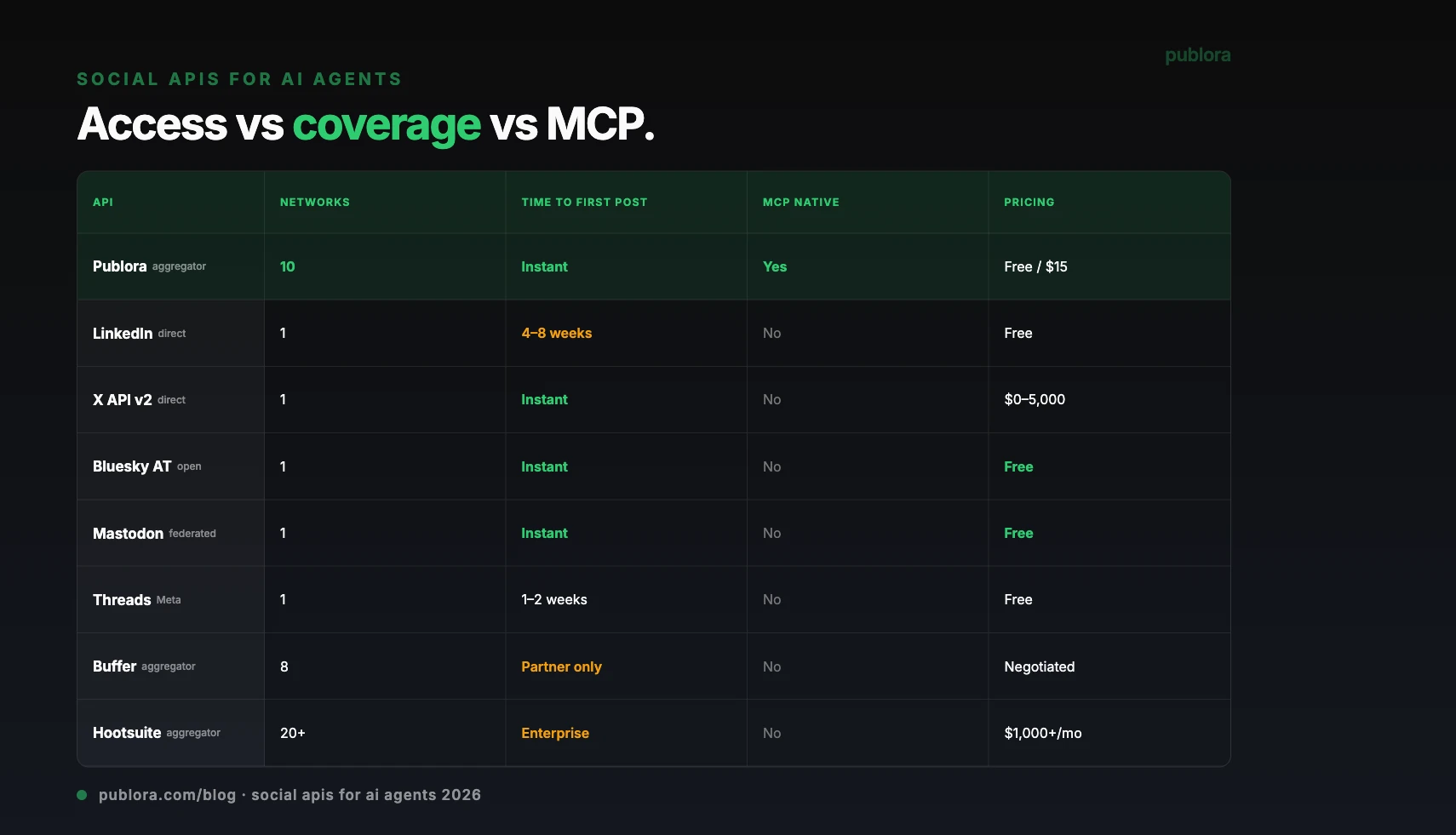
At-a-Glance: API Comparison for AI Agents
| API | Networks | Access | MCP Native | Pricing |
|---|---|---|---|---|
| Publora API | 10 (aggregated) | Instant | Yes | Free / $15 |
| LinkedIn API | 1 | 4-8 weeks | No | Free |
| X API v2 | 1 | Instant | No | Free → $5,000 |
| Bluesky AT | 1 | Instant | No | Free |
| Mastodon | 1 (federated) | Instant | No | Free |
| Threads API | 1 | 1-2 weeks | No | Free |
| Telegram Bot | 1 | 10 minutes | No | Free |
| Buffer API | 8 (aggregated) | Partner only | No | Negotiated |
| Hootsuite | 20+ (aggregated) | Enterprise | No | $1,000+/mo |
How to Choose Your API Stack for AI Agents
- You want one API for many networks, fast → Publora API + MCP. The only practical 10-network aggregator with public access in 2026.
- You're building Claude/Cursor workflows → Publora MCP server. Native tool integration, no glue code.
- You only need one specific network → use the platform-direct API (X, LinkedIn, Bluesky, Mastodon, Telegram).
- You need Bluesky or Mastodon specifically → go direct. The APIs are open, fast, and free.
- You need LinkedIn specifically and have time → apply for LinkedIn API access (4-8 weeks).
- You're on X with budget → X API v2 Basic or Pro tier.
- You're enterprise and already on Hootsuite → Hootsuite Enterprise API.
- You want broad reach, fastest path → Publora (covers 10) + Bluesky + Mastodon direct for the long tail.
Why MCP Changes the Game
If you've built agent workflows that touch external systems, you know the integration tax: each new tool needs auth handling, error normalization, schema mapping, and tool descriptions written for the LLM to understand. Multiply that by 10 social networks and the integration cost becomes the project.
MCP eliminates most of that. Anthropic's open Model Context Protocol standardizes how AI agents discover and call external tools — auth, schemas, capability descriptions are all part of the protocol. An MCP server publishes its capabilities once, and any MCP-compatible client (Claude Code, Cursor, Continue, any custom build) can use them.
For social media specifically, the practical impact is:
- Connect once. Add Publora's MCP server to your Claude config; your agent immediately has posting capability for 10 networks.
- Natural tool calls. "Post this thread to LinkedIn and X" becomes a tool call your agent makes directly, not a back-and-forth between agent → script → API.
- No glue code. Auth handling, network routing, error formatting are inside the MCP server, not in your code.
- Composable. Combine the Publora MCP with other MCPs (GitHub, your CRM, your analytics) to build full agent workflows that span systems.
For more on MCP architecture and use cases, see the complete guide to MCP servers and MCP vs REST API for social media automation.
Frequently Asked Questions
What is the best API for AI agents to post on LinkedIn and social media in 2026?
Publora API + MCP server. Public REST API covers 10 networks (LinkedIn, X, Threads, Bluesky, Instagram, TikTok, Facebook, YouTube, Telegram, Mastodon). The MCP server lets Claude, GPT, and Cursor agents post via native tool calls without glue code.
What is MCP and why does it matter for social posting?
MCP (Model Context Protocol) is Anthropic's open standard for connecting AI agents to external tools. An MCP server exposes capabilities like "post to LinkedIn" as tools any MCP-compatible agent can call. For social media, it eliminates the integration tax of wiring each platform API into your agent.
Can I use the LinkedIn API directly with my AI agent?
Yes, but with constraints. LinkedIn requires app approval (4-8 weeks, often rejected for AI use cases), OAuth handling, rate limit management. For most builders, going through Publora is faster than direct integration.
What about X (Twitter) API for AI workflows?
X API v2 is accessible but pricier. Free tier 50 tweets/month. Basic $200/month. Pro $5,000/month. Aggregator APIs (Publora) absorb X costs into their pricing — usually cheaper than direct X access for sub-enterprise volumes.
Which platforms have AI-friendly APIs in 2026?
Bluesky and Mastodon are fully open. Telegram Bot API is the easiest setup. X, LinkedIn, Threads have official APIs with approval flows. Instagram, Facebook through Meta Graph. TikTok via Content Posting API (heavily gated). YouTube has Data API for videos.
How does Publora's API work with Claude or ChatGPT?
Two ways: (1) REST API — agent generates content, backend script calls Publora endpoints. (2) MCP — connect Publora MCP server to Claude Code or Cursor, agent calls publora.create_post as native tool. MCP is the cleaner integration for development workflows.
Are there free social media APIs for AI agents?
Yes. Publora's API + MCP are free on the free plan, covering 10 networks. Platform-direct APIs have free tiers (X 50/month, LinkedIn if approved, Bluesky and Mastodon fully open). Buffer is partner-only. Hootsuite is enterprise.
10 Networks. One API. Free.
Publora API + MCP server gives your AI agent posting capability for LinkedIn, X, Threads, Bluesky, Instagram, TikTok, Facebook, YouTube, Telegram, and Mastodon — with one tool call. Free plan includes API key and MCP access. Try Publora free.
Serge Bulaev writes about social media APIs, AI agent workflows, and how developers are using MCP to compose multi-platform automations. Founder of Publora and Co.Actor.
Sources
- Anthropic — Model Context Protocol
- LinkedIn — Posts API documentation
- X — Developer Platform
- Bluesky — AT Protocol API docs
- Mastodon — API documentation
- Meta — Threads API
- Telegram — Bot API
Related Reading
- Social Media API: The Complete Guide
- Connect Publora MCP to Claude Code
- The Complete Guide to MCP Servers
- MCP vs REST API: When to Use Each for Social Media Automation
- Build an AI Social Media Agent in Python
- Cross-Platform Posting: One API Call to Publish Everywhere
- Posting to Bluesky via API
- Best AI-Powered Social Media Scheduling Tools 2026