Bounded Autonomy
A framework where AI systems in social media marketing operate independently within predefined constraints, balancing automation with human oversight and strategic control.
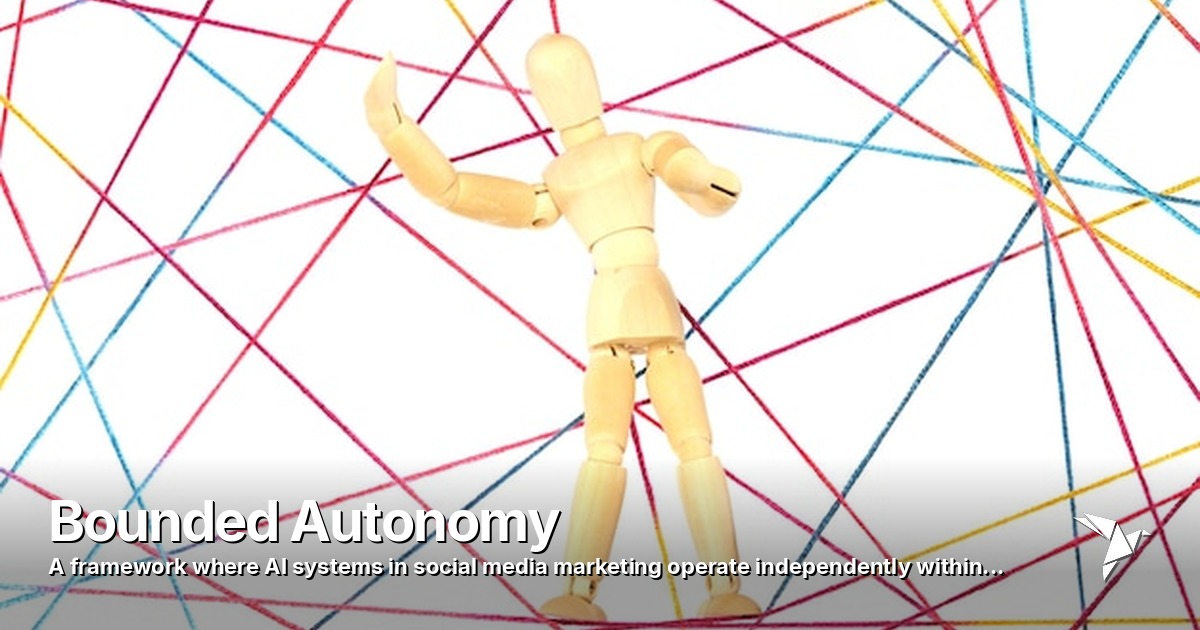
AI autonomy with guardrails - enables smart automation while maintaining strategic control and preventing unintended actions.
Key Points
- ✓Enables AI systems to operate independently within predefined strategic constraints and human oversight
- ✓Boundaries typically cover allowed tools and accounts, budget limits and actions that need human approval, with escalation when limits are reached
- ✓Globant reports 23% higher CTR and 4x more asset creation for early clients of its FUSION suite; these are vendor figures
- ✓Separate from "bounded social media places", a marketing research term for private communities such as closed groups and WhatsApp channels
Bounded autonomy represents a sophisticated approach to AI implementation in social media marketing, where autonomous systems operate independently within carefully defined parameters and strategic guidelines. This framework enables AI agents to make real-time tactical decisions while maintaining alignment with business objectives and preventing potentially harmful or off-brand actions.
Understanding Bounded Autonomy in Social Media Context
In social media marketing, bounded autonomy usually describes AI-driven campaign systems that can adjust bids, reallocate budgets and pivot creative strategies on their own, but only within strategic guidelines set by the marketing team 2. The same idea is used well beyond marketing: industrial AI vendor XMPro describes bounded autonomy as agents that act only within limits people have approved, with anything outside those limits escalated to a human 3.
Unlike full autonomy, which could lead to unpredictable outcomes, bounded autonomy incorporates operational boundaries, decision frameworks, and human oversight mechanisms. This approach mitigates risks such as privacy violations, budget overruns, or brand reputation damage while still leveraging AI's speed and analytical capabilities.
The boundaries typically cover which tools or accounts the agent may use, how much money it may move, and which actions need explicit human confirmation. OpenAI's guide to building agents recommends rating tools by risk and requiring human approval for sensitive, irreversible or high-impact actions, as well as escalating when an agent exceeds a set number of retries or actions 4.
Vendor-Reported Results
Globant describes its real-time campaign optimization systems as operating under bounded autonomy, and reports that early clients of its FUSION AI suite achieved a 23% improvement in click-through rates, a 4x increase in asset creation, 6x faster campaign adaptations, and a 3x reduction in production time 2. These are vendor figures rather than independent benchmarks.
Practical Applications for Social Media Marketers
Marketers leverage bounded autonomy to enable AI systems for real-time optimization while maintaining strategic control. Common applications include autonomous bid adjustments using reinforcement learning algorithms, budget reallocation across platforms within predefined limits, and creative testing through multi-armed bandit approaches 2.
For publishing, a common boundary is the draft: an agent can research, write and queue posts, but a person approves them before they go live (see human-in-the-loop). Tools that expose publishing to AI agents, such as an MCP server, make this easy to enforce when the agent can create drafts but only people can schedule.
Not to Be Confused With Bounded Social Media Places
Marketing research also uses the term "bounded social media places" (BSMPs) for private online spaces such as closed Facebook groups, Discord servers or WhatsApp communities, where access is restricted and communication is more personal 1. That concept is about audiences and community spaces, not about AI systems, and is separate from bounded autonomy. Nike's WhatsApp community for DN8 sneaker drops, which gives members exclusive content from athletes and Nike product designers, is an example of a bounded social media place 5.
Implementation Best Practices
Successful implementation of bounded autonomy requires careful planning and clear operational guidelines. Start by defining specific boundaries for AI actions, such as the maximum share of budget the system may shift between campaigns and which audiences it may target. Establish oversight protocols that trigger human intervention when certain thresholds are reached.
Implement phased approaches, beginning with basic automation like anomaly detection before giving an agent authority over budgets or publishing. Log every action the agent takes so decisions can be reviewed, and adjust the boundaries as the system proves reliable.
Tools and Technologies
Several platforms now offer bounded autonomy capabilities for social media marketing. Globant's FUSION AI suite provides autonomous campaign pivoting within defined parameters, while XMPro's Rules of Engagement framework offers control layers for AI agent operations 3. Multi-armed bandit algorithms enable creative testing with built-in constraints, and reinforcement learning systems can optimize ad performance within specified boundaries.
Analytics dashboards and alerting help people see what an autonomous system has changed, which is what makes the boundaries enforceable in practice.
Sources
- The Power of Bounded Social Media Places: New Frontiers in Digital Marketing
- Real-Time Campaign Optimization and Autonomous Pivoting: The Future of Digital Marketing (Globant)
- Bounded Autonomy: A Pragmatic Response to Concerns About Fully Autonomous AI Agents (XMPro)
- A practical guide to building agents (OpenAI)
- Unreal Motion: Join DN8 Drops on WhatsApp (Nike)
Publora and Bounded Autonomy
The Publora API and MCP server publish and schedule posts to 10 networks from your own code or from AI assistants like Claude, ChatGPT and Cursor.
See the Publora API →