KPI (Key Performance Indicator)
A quantifiable metric that measures how effectively social media strategies achieve specific business goals like brand awareness, traffic, leads, or sales.
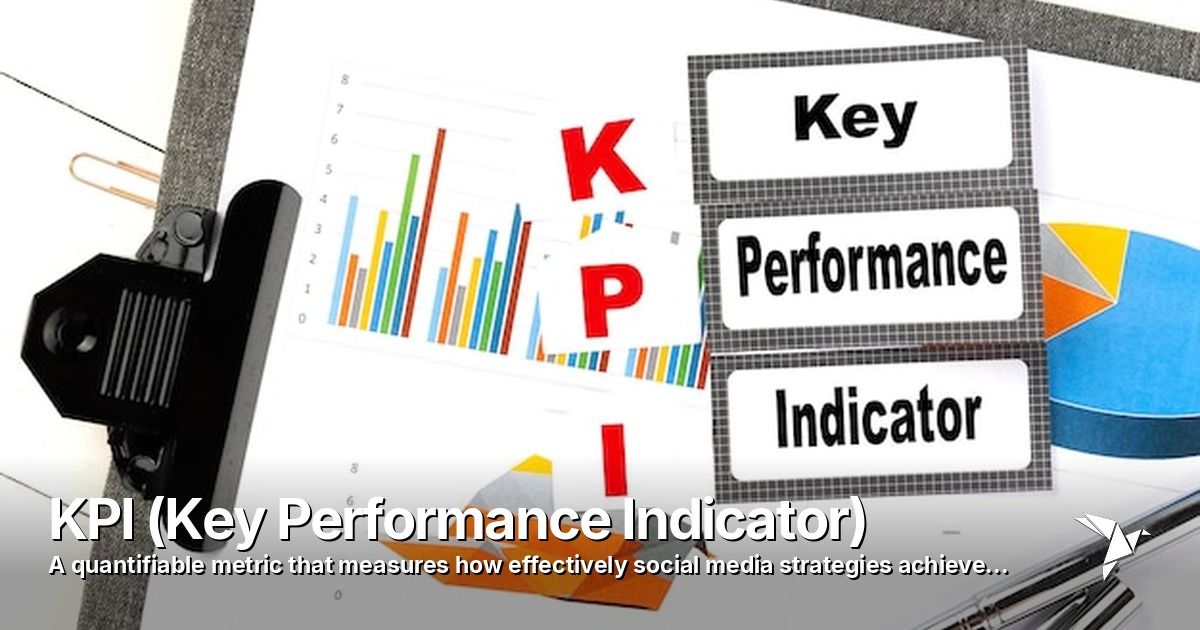
Measurable metrics tied to business objectives that help evaluate social media performance and ROI.
Key Points
- ✓KPIs are quantifiable metrics directly tied to business objectives, unlike general social media metrics
- ✓Four main categories: awareness, engagement, conversion, and customer relationship KPIs
- ✓Choose 3-5 relevant KPIs per campaign and benchmark against industry standards for meaningful insights
- ✓Platform-specific KPIs provide more actionable data than one-size-fits-all metrics across all channels
A Key Performance Indicator (KPI) in social media marketing is a quantifiable metric that measures how effectively social media strategies achieve specific business goals, such as building brand awareness, driving traffic, generating leads, or boosting sales12. Unlike general metrics, KPIs are directly tied to objectives, providing actionable insights to evaluate performance, prove return on investment (ROI), and refine campaigns.
Why KPIs Matter in Social Media Marketing
KPIs bridge the gap between social media activities and business outcomes. While metrics like follower count provide raw data, KPIs connect social interactions to tangible results. For example, tracking engagement rate helps measure brand awareness, while monitoring conversion rates from social ads directly shows sales impact1.
Statista projects worldwide social media advertising spending to reach US$338.75 billion in 2026, which is why marketers rely on KPIs to show what that spend returns 5. This data-driven approach has become essential as businesses demand measurable results from their social media investments.
Core Categories of Social Media KPIs
Social media KPIs fall into four main categories, each serving different strategic purposes:
- Awareness KPIs: Measure brand visibility through reach, impressions, and share of voice
- Engagement KPIs: Track audience interaction via likes, comments, shares, and saves
- Conversion KPIs: Monitor business outcomes like click-through rates, lead generation, and sales
- Customer KPIs: Evaluate relationship building through retention rates and customer lifetime value
Essential Social Media KPIs to Track
Engagement Rate: Measures the percentage of your audience that interacts with your content. Top-performing campaigns are judged against benchmarks for the same platform and industry, because typical engagement rates on Instagram vary widely between sectors.
Reach and Impressions: Track how many unique users see your content (reach) versus total views (impressions). These metrics help evaluate content distribution effectiveness.
Click-Through Rate (CTR): Measures the percentage of users who click on your links. A low CTR often signals that content needs optimization or better call-to-action placement.
Conversion Rate: Tracks the percentage of social media visitors who complete desired actions.
Cost Per Engagement (CPE): For paid campaigns, this metric divides ad spend by the number of engagements received, helping marketers compare efficiency and optimize budget allocation.
How to Set and Track KPIs Effectively
Start by aligning KPIs with specific business objectives. For brand awareness campaigns, prioritize reach and engagement rate. For lead generation, focus on conversion rate and cost per lead3.
Choose 3-5 KPIs per campaign to avoid data overwhelm. Set specific, measurable, time-bound goals—for example, a target follower growth rate for the quarter or an engagement rate you aim to hold above your recent average.
Use platform-native analytics dashboards like Instagram Insights or third-party tools for comprehensive tracking. Regular monitoring allows for quick strategy adjustments when KPIs underperform.
Platform-Specific KPI Considerations
Different social platforms require tailored KPI approaches. On TikTok, video completion rate and shares are crucial for measuring viral potential. LinkedIn campaigns should focus on professional engagement metrics like connection requests and article shares.
For YouTube, watch time and subscriber growth rate provide better insights than view count alone. Facebook campaigns benefit from tracking post saves and event responses alongside traditional engagement metrics.
Common KPI Mistakes to Avoid
Avoid focusing solely on vanity metrics like follower count without connecting them to business outcomes. While a large following looks impressive, engagement rate and conversion metrics provide more actionable insights2.
Don't track too many KPIs simultaneously. This leads to analysis paralysis and dilutes focus from the most important metrics. Instead, select KPIs that directly relate to your primary campaign objectives.
Benchmark your KPIs against industry averages and your historical performance. What counts as a good Instagram engagement rate depends on account size and industry, so compare your results with benchmarks for similar accounts rather than a single universal number.
Using KPIs for Strategic Decision Making
KPIs enable data-driven optimization of social media strategies. When engagement rates drop, analyze content themes, posting times, and hashtag performance to identify improvement opportunities.
Use A/B testing to optimize KPIs systematically. Test different content formats, captions, or posting schedules while monitoring their impact on your chosen metrics.
For Publora users, integrated KPI tracking across multiple platforms provides a comprehensive view of social media performance, enabling more informed strategy decisions and efficient campaign management.
Publora and KPI (Key Performance Indicator)
Publora analyzed 54,439 posts from 2,118 users: which networks they use, which days they post and how far ahead they schedule.
Read the scheduling study →